Think orchestral TEDTalks. Every concert below can be adjusted to run within a window of 60–90 minutes, and is performed without an interval.
What kind of culture do the people in a community want to have available? And if the sort of strictly classical canon isn’t a culture that they’re interested in, is it because they’re not interested in that particular music, or is it because the presentation of that music just isn’t interesting? It’s a very interesting coin to start turning around and seeing.
Mid the Pines podcast, 2024 · 0:00 / 0:21
I think at the end of the day we need to take more time in developing the human element of our concerts, whether that means letting the conductor or some of the players engage with audiences or showing a certain strand or line of programming.
It might be wrapped around a single poem that people connect to on a very visceral level then showing that there’s some music that reflects this poetry. So they’re not coming to a concert to hear curated museum pieces, they’re coming to a concert to discover more about humanity, about themselves and about somebody else.
Classical Music, January 2019
It would have taken little, and I would have ended my own life — only art, it held me back.
Heiligenstadt Testament, 6 October 1802.
“I would die, but for my art”: Beethoven’s Symphony No. 2 & his Heiligenstadt Testament
In the summer of 1802 Beethoven wrote two of his most historical works — The Second Symphony, and his Heiligenstadt Testament. One was a musical explosion of joy, with long heroic themes. The other was an intensely personal testament written in anguish, acknowledging the certainty of his impending deafness and agonizing over the questions of his future. Hear the weaving of his personal words intertwined with one of his most extraordinary and well-loved symphonic works, and be astonished how he overcame the sorrow of his Testament and resolved himself to “his art”, in order to produce one of his most compellingly joyful symphonies.
Music from Mozart’s Letters
Known for his off-color commentary and copious anecdotes, come enjoy the music that Mozart himself mentions in his letters, whether by him or by others, and hear just what the musical prodigy thought about it all!
The new Haffner symphony has quite surprised me — for I no longer knew a word of it; it must surely make a good effect.
To his father, Vienna, 15 February 1783.
MIXTAPE Brahms
An exploration of Brahms through his best (and perhaps less familiar, but equally beautiful) music, including orchestral works as well as songs and lieder that he wrote for voices. The concert is bookended by the first movement of the First Symphony, and the last movement of the Fourth Symphony.
The Stories that Saved her Life: Scheherazade
Come hear how a young brave woman saved her own life, and all the lives of the women in her city, through love and her intoxicating storytelling that would come to be known as The Arabian Nights.
But the sultana Scheherazade saved her life by holding his interest with the tales she told him over 1001 nights.
Rimsky-Korsakov’s programme, printed before the first page of the score.
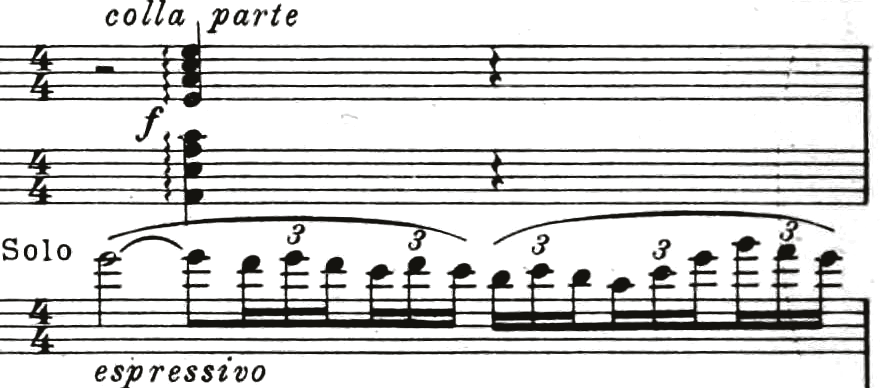
Score, page 4, after the orchestra’s held chords — the harp’s chord and the solo violin.
(Rimsky-Korsakov Scheherazade: The Sea and Sinbad’s Ship; The Story of the Kalendar Prince; The Young Prince and the Young Princess; The Ship Breaks against a Cliff Surmounted by a Bronze Horseman).
Journey through the Museum: Pictures at an Exhibition
In a concert inspired by art, come see and hear the visual journey walked by Modest Mussorgsky as he celebrated the artistic exhibition of his dear friend Viktor Hartmann.
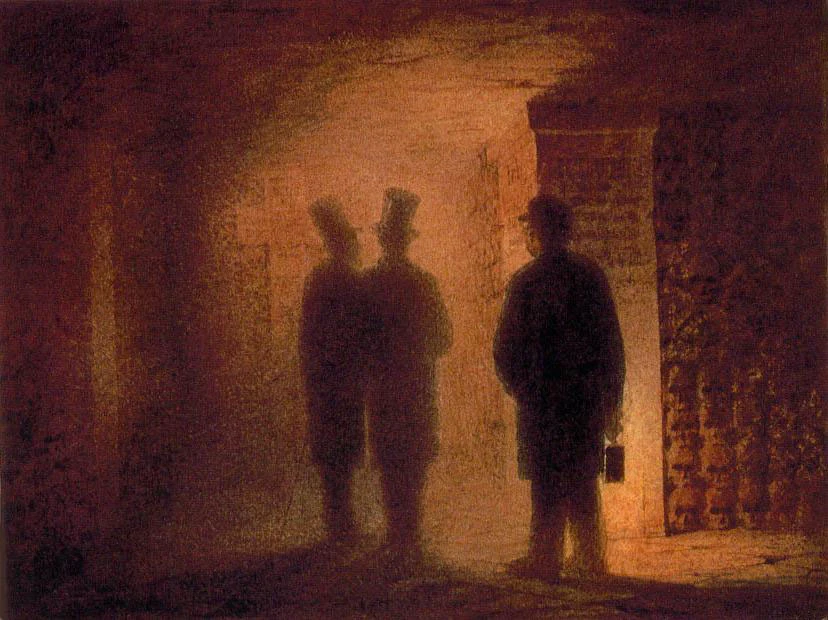
Viktor Hartmann, The Paris Catacombs. Hartmann is in the picture, with Vasily Kenel and a guide holding the lantern.
This concert requires a screen above the orchestra.
This concert on one pageDraft: one page an orchestra manager can forward, with my guesses marked in blue. The other five programmes get one once this one is right.
The Women’s Orchestra of Auschwitz
A concert telling of the immeasurable history of the Women’s Orchestra in Auschwitz-Birkenau which was conducted by Alma Rosé (the niece of Gustav Mahler), using repertoire from the orchestral canon that was actually performed by the Women’s Orchestra in Auschwitz, and sharing first-hand account by orchestra members intertwined with historical documents and diary recollections from other prisoners.